Evaluation
There is no separate test suite to write. Every active
certified answer is a regression test: it pins a
correct value, so certifying an answer and writing its test are the same act. The
suite runs on demand (dst test), as a gate inside dst apply, and on
whatever schedule your CI or cron gives it.
The corpus is the suite
For each active certified answer, the stored SQL is the oracle — the known-good reference the test compares against:
- Execute the certified SQL, read-only, capped at 1000 rows — and compare over at most 1000 rows from either side. Certified answers are small verified aggregates, so they fit by construction.
- Ask the question again through the real generation path. Certified matching is switched off by construction (testing the serve shortcut would trivially pass), and the answer under test is excluded from its own examples — with them, it would match itself almost perfectly and the suite would be grading copying.
- Execute what generation produced and compare the two executed results: a set difference, ignoring column order when both sides name the same columns, with a 1e-9 relative tolerance on single scalars (the order of an aggregation alone can wiggle a floating-point number's last bits). One deliberate leniency: when the oracle is a single count of 2 or more, a generated result carrying that many rows passes — "how many X" and "which X" are the same answer at two grains.
Both sides run back-to-back against the live warehouse, so there is no
snapshot to drift from: the oracle is the certified SQL run now. A diverging
case re-runs generation once before it counts, to absorb model randomness;
flapping that survives the re-run is signal. A divergence prints both executed
values and the choice it forces: fix the definition, or re-certify/retire the
answer. A green answer in dst test or the apply gate is a
re-verification: its bindings — the recorded hashes of the shared assets it
depends on — re-stamp to the current versions.
Generation inputs come from the same assembly seam serving uses (retrieval, profile enrichment, exemplar folding, generator tiering), so the suite grades the pipeline production actually runs. Each result records what was assembled, so a leaner-than-production run (say, no embedding provider configured) is visible, never silent.
Running it
dst test            # every published lens
dst test finance    # one lens
dst test --all      # explicit form of the default
Runs in-process against the configured database, like migrate: no server,
token, or URL needed. Always the full active corpus (the apply gate scopes
to what a push touches; this command is the cron/CI sweep). Exit 1 on any
divergence or failed expectation.
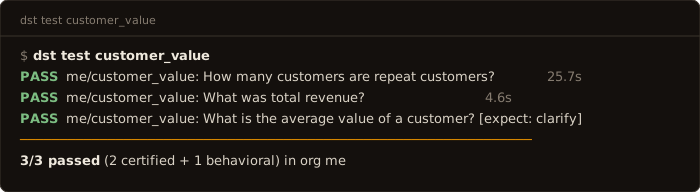
Every run is recorded: dst test persists the run and its per-case results in
the same tables the publish gate writes, so accuracy is a queryable trend —
dst runs <lens> lists the recorded runs, and dst runs <lens> --diff A B
compares two (score delta plus per-case flips; exit 1 on a regression).
Once a lens serves real traffic, dst evals from-traffic <lens> drafts new
cases from the request log, with the observed outcome shape as the
expectation.
The cadence is yours — run the sweep from CI, cron, or a deploy pipeline
(see Environments and CI); there is no in-process
scheduler to configure.
Three lanes under typed serving
With a typed-decision provider configured,
dst test grades three different things, each with one owner for its failures:
| lane | compares | a failure belongs to |
|---|---|---|
| resolution | the provider's decisions for each certified question against the answer's typed gold — lens, entity, metric, dimension, grain, filter column and value | the layer (option sets, descriptions, readings) or the decider |
| compile | the SQL compiled from those decisions against the certified SQL, canonicalised | dst — a layer that does not compile is a product defect, caught at dst plan |
| data | the certified SQL executed against the warehouse and compared to its stored result | the data: a load, a backfill, a schema change |
The first two need no warehouse and run in seconds per corpus. The third is the only one that pays warehouse time, and by default it runs only for the cases the first two could not prove — a case whose compiled SQL is identical to the certified text is proven without a query.
dst test                 # resolution + compile for every case; data only for the unproven
dst test --slots         # resolution + compile only — nothing executes
dst test --repeat 20     # each question resolved 20 times; a case passes only when every run agrees
dst test --rows          # execute every case — the data-drift check
Answers certified before typed serving carry no typed gold; they grade against gold attributed from their certified SQL, and a green typed run stores the typed gold for next time.
Behavioral cases: pinning shape
lenses/<name>/evals/cases.yaml holds the behavioral cases: cases that pin the
shape of a response, not its value. A case declares
expect: clarify | refuse | answer, plus an optional term — the term a
clarify must name, ignored on the other two shapes.
Each case runs through the real pipeline — including the deterministic clarify
and exclusion pre-checks, since that is the behavior being pinned — and passes
only if the response comes back in the expected shape: a clarification, a
refusal with no data served, or a data answer. Shape is the one thing a value
test can't express, and expect: answer measures refusal in both directions:
a lens that drifts into refusing an answerable question was previously
invisible unless that question was certified. Approved behavioral cases run
alongside the certified suite in dst test and in the gate. (Legacy value
cases with expected SQL are not scored anywhere: certified answers are the
regression suite; dst evals migrate converts them into certified answers.)
The gate on publish and apply
eval_gate: off | warn | block per lens, default block: a certified answer
gates by default, the way a dbt test blocks by default. A fresh lens with
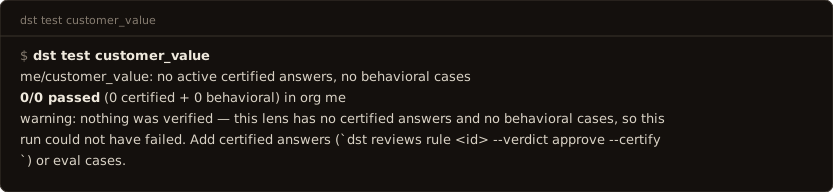
nothing certified publishes with a loud "gate SKIPPED" line, never a refusal.
One shared check runs inside interactive publish and inside dst apply;
apply cannot bypass it. A blocked publish returns 409 with the score, the
previous score, and the failing cases. Under warn, the same findings surface
loudly and publish proceeds.
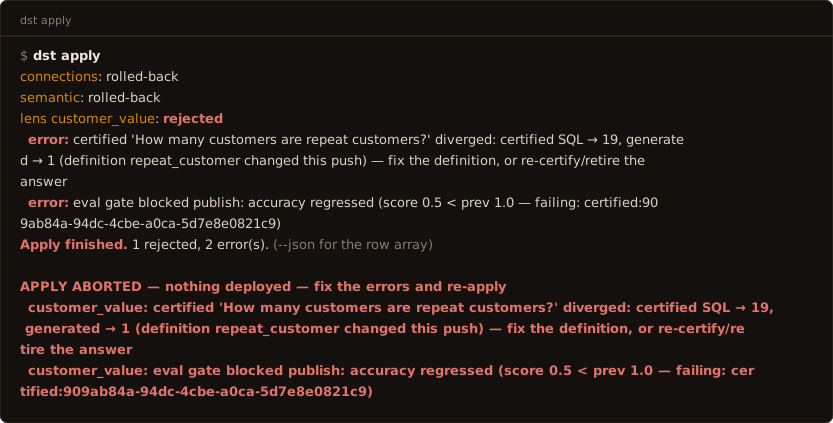
On apply, staleness picks what to test: only active answers whose stored
bindings disagree with the push's asset hashes run, which keeps it cheap by
construction. A certified divergence under block is an error in its own
right, not merely a score change. And the abort is blue/green and atomic: the
whole apply rolls back, the prior versions keep serving, and the staged eval
run and binding re-stamps roll back with it. A rejected apply can never lower
the gate's baseline for the next one.
The answers a push itself lands get fresh bindings, so the staleness selection
never picks them. Instead, certifying tests itself: an answer the apply
creates or SQL-re-authors runs through the same suite in the same apply,
generation against the just-stored oracle. A divergence here is an alert,
never a block: divergence at certification time can be the point (the
certified answer overrides generation), so the warning names both executed
results and asks you to re-check the oracle if override wasn't the intent.
The self-test is unconditional: eval_gate governs the publish gate,
never this; applying a certification tests it and alerts, period. Edits that
touch only provenance or status verify nothing new and are not re-tested.
Two things stop it reaching an answer, and both say so out loud with the
landed untested nudge toward dst test: generation cannot serve the lens at
all (the lens's model does not resolve, no connector), or the apply runs out of
its self-test budget. That budget is wall-clock — DST_CERTIFY_SELFTEST_BUDGET_S,
default 120 seconds — because apply holds the org's lock and its transaction open
for the whole run. Read it in answers, not seconds: at roughly 30 seconds per
generation it covers about four, so a larger push lands the remainder untested by
design and dst test sweeps them unbounded.
A configured gate that cannot score (no smart-tier model resolves, nothing to
run) stands down loudly, with the reason in the publish/apply output, so a
gate that did not run is never mistaken for a gate that passed. One starvation refuses
to stand down at all: under eval_gate: block, an apply that empties the
active certified corpus — retiring the last active answer, or deleting its
file entry — aborts instead of publishing over an emptied corpus. Keep at
least one active answer, or set eval_gate: warn/off in lens.yaml and
re-apply. Under warn, the same ≥1→0 transition publishes but warns, in
the apply row itself: even when approved behavioral cases keep the gate
scoring, the certified gate now has nothing left to test. The scope is exactly
the ≥1→0 transition: a lens that never had active answers (a fresh lens doing
its first applies under block) is untouched.
Scored three ways
The suite on this page is pass/fail per case. Where dst measures answer quality more broadly — the benchmark harness, and Observe's per-lens columns — it scores three ways (correct / wrong / declined), with wrong-rate as a co-headline, because a wrong answer is worse than no answer. Declining is the correct response for a question whose data does not exist; a confident number there is a hallucination by construction.
Definitions and exemplars generalize beyond the questions they were written for: they ground questions whose SQL is not in the certified library.